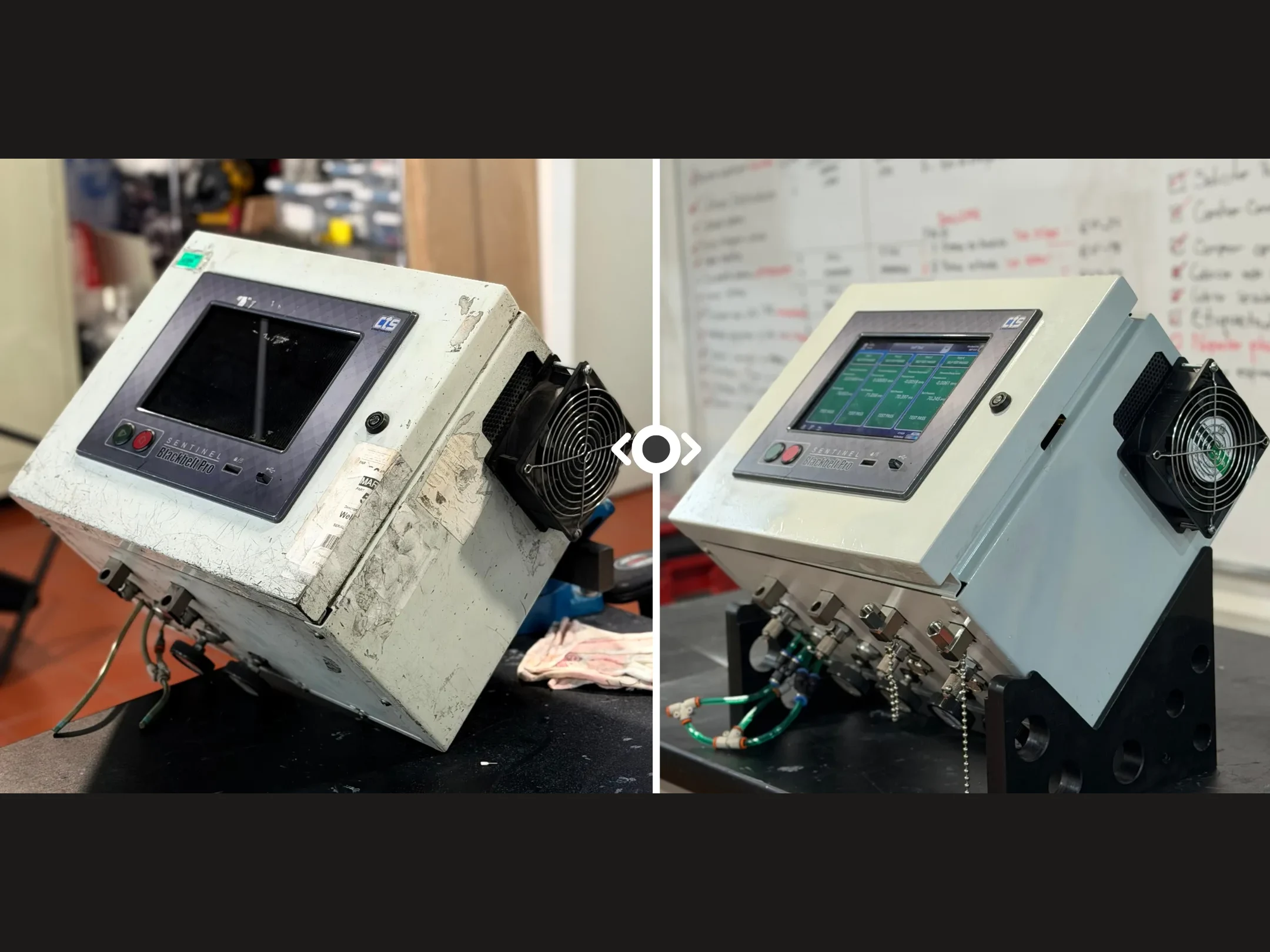
Why does your leak test have so many “false rejects”? The key isn’t in the sensor — it’s in how you program the sealing.
The common mistake: constant pressure
Applying air pressure continuously during measurement is a critical mistake:
- Fluctuations in the plant’s air network — pressure drops caused by other machines — are transmitted to the seal.
- The seal deforms dynamically, changing the volume of the test cavity.
- The result: mechanical variations that the sensor reads as leaks.
The master sequence: three-stage logic
We implement a control logic in the PLC that prioritizes mechanical stability over brute force:
- Approach — The actuator reaches a mechanical stop, not an air-pressure setpoint. This ensures the chamber volume is constant on every cycle.
- Stabilization (1.6 s) — A time calculated for this type of elastomer and cavity volume. The exact value varies with the seal material and the part geometry; what doesn’t vary is the need for this stage: without it, any differential reading is noise.
- Isolation — With CKD 5/3 closed-center solenoid valves, the flow is cut once the stop is reached. The air stays “trapped” in the actuator and the measurement happens in a static, controlled environment, isolated from the plant’s pneumatic network.
The impact on the R&R study
This improvement in the logic doesn’t only speed up cycle time by avoiding re-tests; it ensures your Gage R&R (Repeatability and Reproducibility) meets the strictest standards of the automotive and aerospace industries:
- Reduced standard deviation in the measurement.
- Elimination of pneumatic noise.
- Longer-lasting sealing systems.
At Lübeck we don’t just build stations; we design stable processes under international standards. Is your leak-test process repeatable, or are you just getting lucky?