In the automotive, medical, electronics, and manufacturing industries, component identification has stopped being a simple marking operation. Today, every serial number, Data Matrix code, QR code, or production data is part of the traceability required by customers, audits, and quality systems.
Yet many plants still use technologies designed for a different reality: adhesive labels, inkjet printers, thermal-transfer systems, or contact marking.
The question is: what happens when a label peels off, a print loses contrast, or a printhead needs maintenance in the middle of production?
The hidden costs of labeling and inkjet
At first glance, a label or an inkjet printer looks like a low-cost solution. But when you analyze the total cost of operation, factors appear that are rarely considered:
- Ongoing purchase of consumables.
- Label replacement.
- Printhead cleaning.
- Ink changes.
- Downtime for maintenance.
- Read failures in vision systems.
- Loss of traceability from damaged or detached labels.
In high-volume applications, these costs can add up over the years.
Why are more manufacturers migrating to laser marking?
Unlike other identification methods, laser marking creates a permanent mark directly on the part. It requires no ink, labels, solvents, or printing consumables.
It also lets you generate serial numbers, Data Matrix codes, QR codes, logos, variable information, and production dates and lot numbers — all with high precision and excellent repeatability.
A mark that lasts the entire life of the product
In many automotive applications, components must remain identifiable years after they were manufactured. Labels can peel off. Prints can degrade. But a properly designed laser mark lasts the entire service life of the part.
For that reason, laser marking has become a widely used technology for automotive components, steering systems, electrical components, medical devices, tools, aerospace components, and electronic products.
The laser is only part of the solution
One of the most common mistakes is thinking that buying a laser marker automatically solves the application. The reality is that a project’s success depends on many factors:
- Type of material.
- Required cycle time.
- Mark size.
- Desired contrast.
- Part positioning.
- Integration with PLC and MES systems.
- Validation through vision systems.
That’s why the marking station is as important as the laser itself.
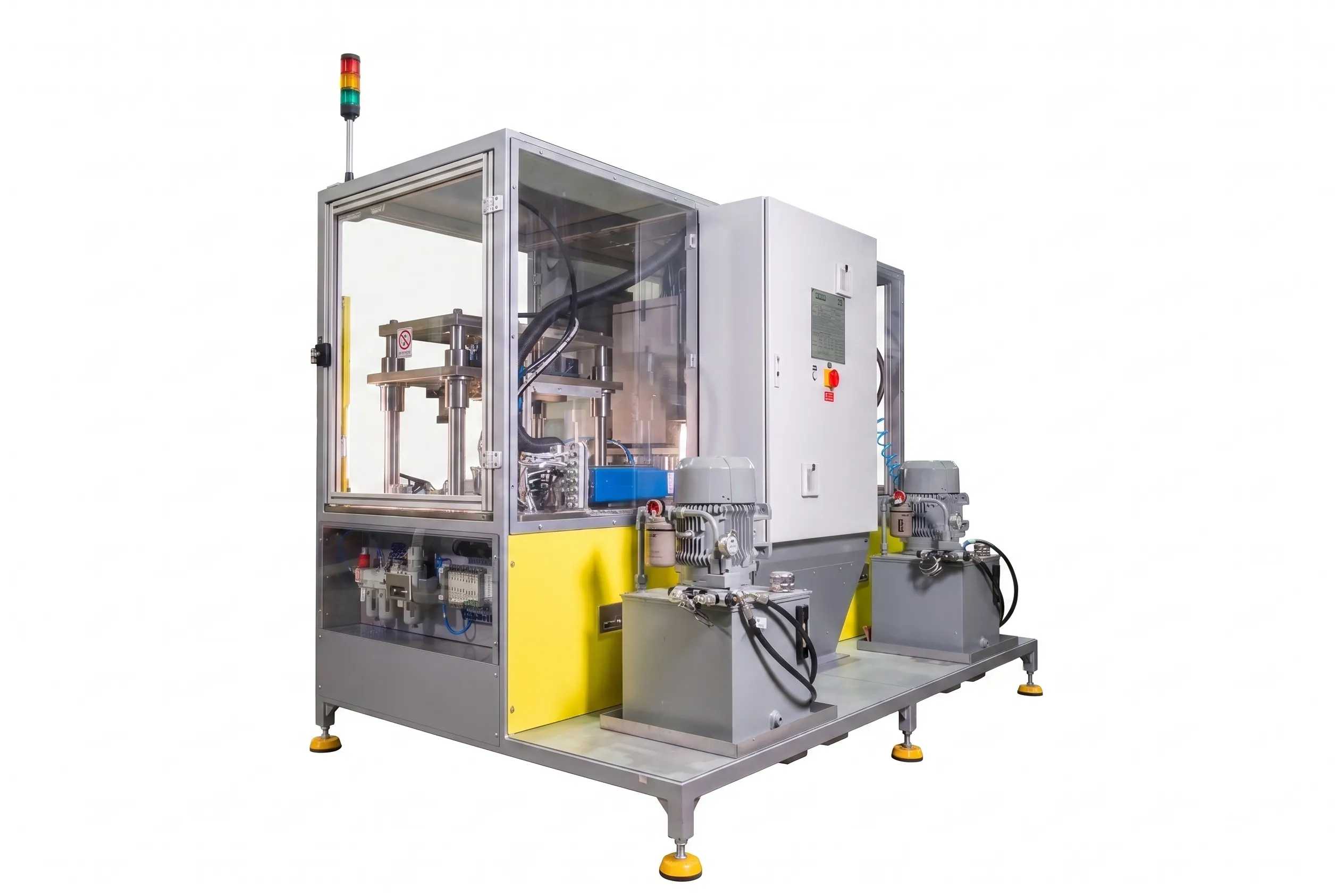
At Lübeck we design complete laser-marking stations
In addition to supplying Brady (formerly MECCO) laser-marking technology, we have the capability to design and build complete stations tailored to each process. Depending on the application, we can develop solutions that include manual, semi-automatic, or fully automatic stations, robot integration, code reading and verification, production traceability, PLC and manufacturing-system interfaces, and Class 1 laser safety systems.
Every project is designed considering the real operation of the plant, the required cycle time, and the customer’s quality standards.
Modernizing existing systems
Many companies still run labeling equipment or inkjet systems installed years ago. In many cases, it’s possible to modernize these stations by replacing the existing technology with laser marking without completely redesigning the line.
The migration can deliver significant benefits: elimination of consumables, lower maintenance, better traceability, higher equipment availability, fewer operator errors, and a lower total cost of ownership.
Is it time to migrate to laser marking?
If your operation shows any of these scenarios, it’s worth analyzing a laser alternative:
- High label or ink consumption.
- Frequent maintenance problems.
- Hard-to-read codes.
- Permanent traceability requirements.
- An increase in quality audits.
- A need for automation.
- Pressure to reduce operating costs.
Conclusion
Traceability is no longer limited to placing a label or printing a part number. Today it represents a critical part of quality, manufacturing, and product information.
At Lübeck we help our customers evaluate, design, and implement laser-marking solutions using Brady (MECCO) technology, developing complete stations that integrate into current production processes. Because the goal isn’t only to mark a part. It’s to ensure the right information stays available for the entire life of the product.